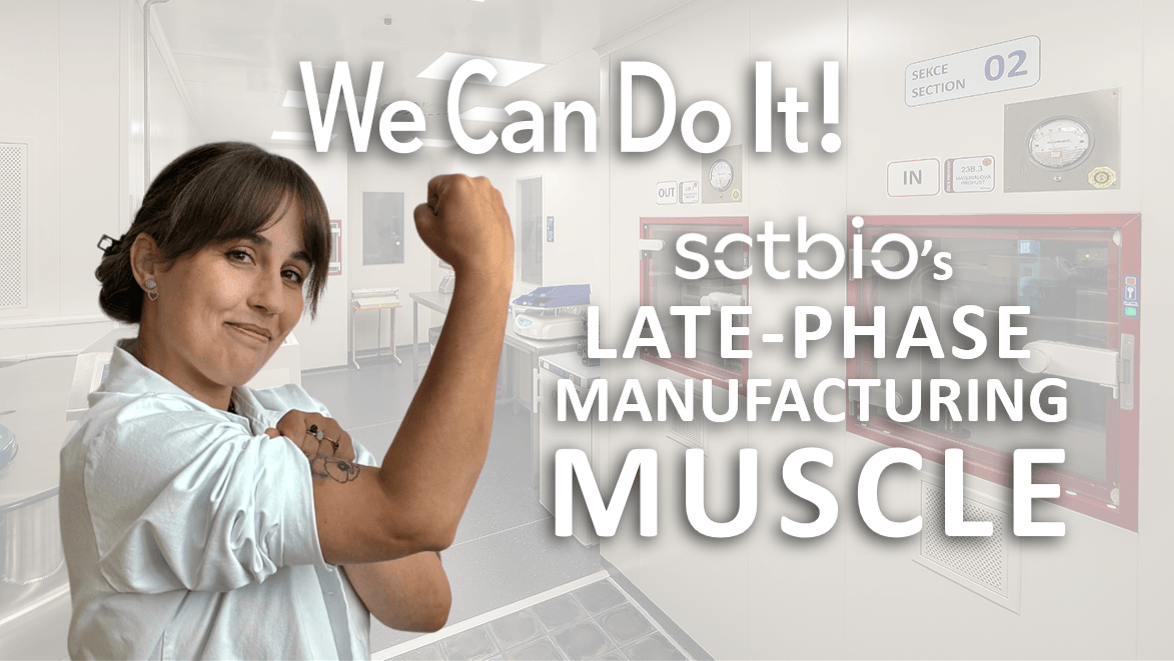
We Can Do It! SCTbio’s Late-Phase Manufacturing Muscle
October 22, 2026 | By Albert Pineda, PhD
In a changing landscape where major CDMOs are restructuring or closing cell and gene therapy (CGT) facilities across key regions, sponsors running late-stage clinical trials cannot afford disruption. As a 100% CGT-focused partner, SCTbio knows exactly the critical risks sponsors face when forced to move an established Phase II or III program: scaling to hundreds of patients while managing complex biological, logistical, and operational variables may trigger program delays, lost slots, and instability that can threaten timelines and years of investment.
At SCTbio, Head of Manufacturing Klára Murcková brings a hands-on perspective to all these challenges. She joined the CGT field 14 years ago as a manufacturing associate in a dendritic-cell program entering Phase II, and progressed through manufacturing, QC and supervision, including technology transfer to China. Having worked both on the floor and in leadership roles, she has seen firsthand how processes work on paper and in the cleanroom:

Klára Murcková, Production Manager at SCTbio
“When clients come to us after a site closure or change at another CDMO, their biggest concern is usually time. We bring together Manufacturing, Quality, Process Development, and Project Management very early. For me, the goal is simple: keep the transfer smooth, maintain product quality, and keep the program on track.”
Built for Scale
SCTbio’s manufacturing muscle is built on decades of experience with large late-phase projects and the industrial-scale capacities developed along the way. That combination provides the infrastructure and flexibility to support high-volume clinical manufacturing. Klára explains what that means in practice:
“We had to learn how to operate at that scale of manufacturing right from the start because our very first program became a major Phase III trial. Since then, we’ve produced over 2,000 GMP clinical batches and delivered over 12,000 IMPs worldwide. In Phase III, we’ve run monthly peaks of 35 dendritic-cell or 25 CAR-T batches without even hitting full capacity, which makes 40 batches per month a realistic target. With 13 GMP suites, we can also run multiple, physically segregated programs in parallel.”
SCTbio operates 420 m² of high-specification GMP cleanrooms across Grades A, B, and C, with segregated suites and room availability for autologous and allogeneic programs. During process development, GMP-identical equipment allows staff to work hands-on with the process before transfer, supporting a smooth transition into GMP manufacturing.

Automated cell washing on the LOVO system
Just the Starting Point
But when launching a new program, having available space is only part of the challenge:
“Cleanrooms are important, but they’re just the starting point. Real capacity means being ready to move quickly into tech transfer, with trained people, the right equipment and processes ready to roll. Every program is different, and once you put a process into a GMP environment, you start asking questions that may not appear in an SOP: how operators move through a room, how long a step takes, how many people are needed, what happens if something behaves unexpectedly, or whether we can accommodate unusual requirements within our existing setup. We question every step to identify critical gaps early and improve robustness before manufacturing begins.”
The same practical mindset shapes SCTbio’s approach to automation. The company uses closed systems including CliniMACS Prodigy, SEPAX and LOVO to streamline cell processing. But automation does not make biology predictable: starting material from heavily treated patients can behave unexpectedly, with cells failing to expand or lymphocyte counts falling below target. Klára sees it from a different angle:
“Early in my career, many processes were more manual. You developed a feel for them. Sometimes that experience still helps because you understand what is happening as the instrument runs. Automation makes processes more reliable and less operator-dependent. But it is still a tool. Experienced people remain essential to recognize when something does not look right. At the end of the day, we still need to use our own good judgment.”
Every Batch Represents a Patient
Late-phase production must account for uncertainty well beyond the cells themselves. In autologous therapies, cells are collected from each patient and shipped for manufacturing into that patient’s batch, so courier problems, flight cancellations or customs holds can delay production; and the treatment that patient depends on. The schedule must anticipate these operational variables:
“Every batch represents a patient, so missing a manufacturing window is unacceptable. When expecting leukapheresis material, we schedule manufacturing and QC operators, and we are on call if there is an issue. When international shipments are delayed, our teams adapt immediately, preparing for multiple worst-case scenarios before the product arrives.”
And timing can be critical even without delays. Patient material from collection sites across Europe, the US, or China often has narrow windows. Once manufacturing begins, fixed intervals leave little room to recover lost time. SCTbio balances speed with the right setup:
“When possible, we keep manufacturing within normal hours to minimize human error and ensure full technical support. But cell therapy does not always run to schedule. If a courier arrives at 1:00 AM, operators may start immediately to avoid delays. We adapt our schedule to the product, not the other way around.”
CGT Is Our Only Focus
That responsiveness is supported by SCTbio’s integrated model: Manufacturing, Logistics, QC, Microbiology, QA and Qualified Persons work within one organization, with a fully in-house microbiology department and validated sterility testing directly connected to the manufacturing floor. This reduces third-party handoffs, communication delays and breaks in the chain of custody:
“For me, the advantage is having these functions in-house. Information does not have to pass through several external organizations before it gets back to manufacturing. QC, QA, QPs and Microbiology are involved from the start, and when something unexpected happens, the right people can talk to each other straight away. It helps us keep the batch on track and avoid surprises at release.”

SCTbio’s 420 m² GMP cleanroom facility (Grades A/B/C)
That same commitment also shapes SCTbio’s continuity. Large CDMOs may appear stable, but shifting corporate priorities, restructuring, and closures often disrupt entire teams and process expertise. Klára explains how a CGT specialist partner protects your program:
“Because CGT is our only focus, your process knowledge becomes a permanent asset. It is less about keeping the same people forever and more about systematically locking in all the know-how. We do this through rigorous training, documentation, and knowledge transfer. People can change, but our framework guarantees that this critical expertise stays deeply embedded in the company.”
This dedication to keeping the workforce current is further strengthened by SCTbio’s GMP-identical equipment mirrored across cleanrooms and process development laboratories, allowing staff to train on the systems they use. Ongoing training, hands-on repetition, and deep operational expertise build consistency and reliability.
Come and See for Yourself!
Ultimately, Klára’s story captures the essence of what SCTbio is today: a company able to handle the demands of late-phase manufacturing without losing its hands-on approach. For anyone used to the steep production costs in markets such as the United States, this naturally invites a question: how exactly can SCTbio offer late-phase, high-volume manufacturing capabilities while keeping costs down, without cutting corners on quality or compliance? Klára offers a clear answer:

The SCTbio GMP cell manufacturing building in Prague
“Lower costs don’t mean lower quality. Every European country follows the same European Medicines Agency standards, among the toughest in the world. Our cost advantages come from local labor rates and lower operating costs in Central Europe; not from lower expectations. Quality is proven through compliance, execution, and results. We operate under GMP daily and welcome regular audits of our facility, systems, and data. The answer is simple: come and see for yourself.”
For late-phase cell therapy sponsors, this combination of proven high-volume manufacturing, hands-on flexibility and integrated in-house operations is the foundation for the reliability and consistency that clients expect from a trusted CDMO… and the core of SCTbio’s manufacturing muscle.
Have a challenge to solve? Let's talk!
If you need cGMP cell manufacturing, viral vectors, process development, or end-to-end CDMO support, our team is ready to help.
or visit us at www.sctbio.com
Want to learn more?
This article is part of our series on SCTbio's expertise, case studies, and ATMP programs. Discover more insights in previous publications: