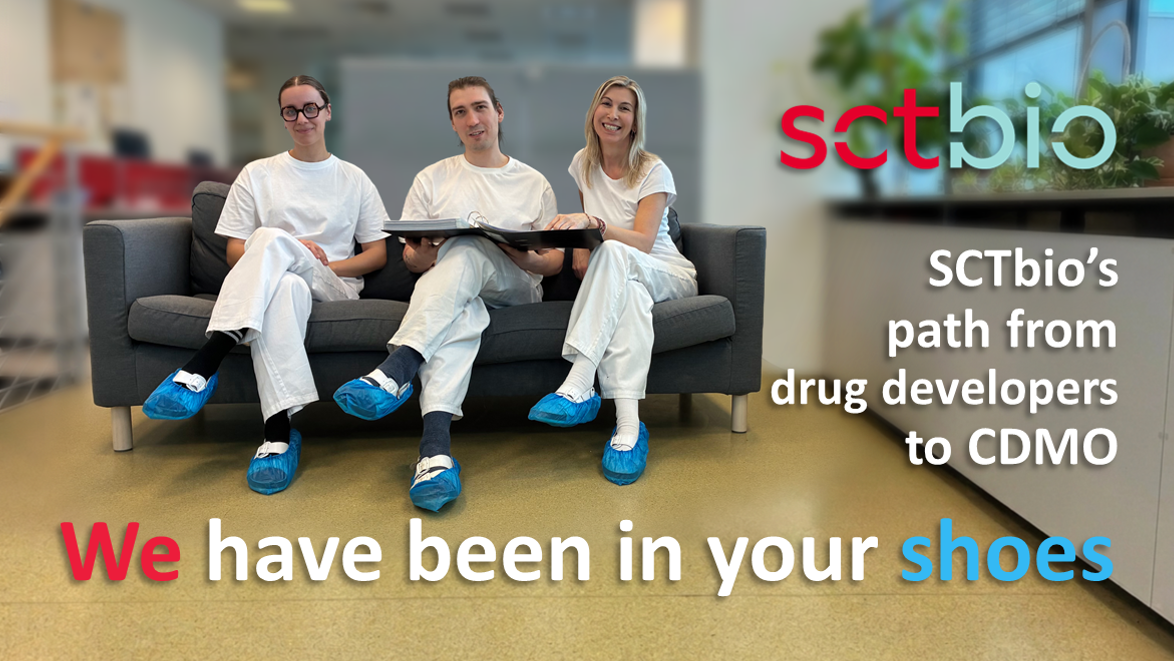
We’ve Been in Your Shoes: SCTbio’s path from drug developers to CDMO
April 29, 2026 | By Albert Pineda, PhD
If you’re an academic moving your cell therapy program from the lab into clinical development, SCTbio’s story will sound familiar: it was built by people who had already lived under the same pressures you’re under. The challenge wasn’t just the science; it was translating a research project into a GMP‑compliant, regulatory fit product: establishing robust QC, PD and CMC systems, validating logistics, scaling manufacturing, and ultimately creating a process that survives the demands of late phase trials, so patients still receive their much-needed treatment. SCTbio’s advantage is that it learned all of this as a sponsor before becoming a CDMO and now brings that mindset to derisk your program… because we have been in your shoes and understand what you’re facing.
From Academia to Drug Development
That's why the perspective of Daniela Rožková, Chief Technology Officer at SCTbio, matters so much to this story: she brings the people and experiences behind SCTbio’s journey to life. Daniela helped build the company from the original single-room hospital GMP unit at Motol into today’s 2,000 m² industrial facility; lived through the stress of clinical development; built Process Development and Quality Control; and helped turn that experience into a CDMO service model. For early-stage founders, that means SCTbio has already been where you are now; for late-stage sponsors, it means SCTbio has already handled the scale, regulation, and operational pressure you face every day.
"I have always felt there is a higher purpose; that we can truly help patients and do something meaningful. I started with a PhD on tumor immunology, focusing on dendritic cell vaccines, which later became the dendritic cells project. Scientifically, it was new and exciting, and it led to publications, but the real turning point was when we had the chance to translate the research into clinical treatment. What had only been a vision in grant applications suddenly became real. When Professor Jiřina Bartůňková said we would build a GMP unit and start treating patients, that was the first real breakthrough."
Long before SCTbio existed, Daniela was working at the Department of Immunology at Charles University and University Hospital Motol, where Prof. Bartůňková’s group had already developed a strong scientific foundation in cell biology, including a small GMP unit to treat patients with dendritic-cell-based therapy. That initial move from research to GMP work marked the beginning of her operational discipline.
"Because there was no external manual to consult on how to set up the procedures, we had to be the ones defining them, building the GMP-compliant infrastructure and logistics. I essentially managed everything that our manufacturing and quality control teams currently do at SCTbio: raw materials, QC, manufacturing, and CMC writing. I worked very hands-on, together with just two or three colleagues, because we did not have dedicated departments."

Dr. Daniela Rožková, Chief Technology Officer at SCTbio
The next step came in 2010, when Professors Jiřina Bartůňková and Radek Špíšek secured support from PPF Group for their cell therapy project. Daniela describes it not as a single step, but as a strategic evolution:
"The logic at that stage was to professionalize our research and enable the shift to the private sector. PPF collaborated intensively with our academic team and provided significant investment into developing corporate and manufacturing backbone; combining our scientific strength with the operational “muscle” needed for global clinical trials. Over the following decade, we established a world‑class GMP facility in Prague within the SOTIO company, and in 2021 SCTbio emerged as a PPF‑backed specialized CDMO."
Lessons Learnt First-Hand
Daniela’s lessons here are the ones every drug development team eventually has to learn: how to prepare for the next steps, what to ask from a partner who has already lived through the transition, what she would do differently in hindsight, what the main warnings are, and how to identify blind spots and avoid common mistakes once a project moves beyond the academic setting. And the very first lesson is on time:
"The company’s ambition was to take the product all the way through Phase III and register it, with a plan to be registered in 2019. The timeline was extremely tight, so there was limited time for optimization and for setting up robust procedures to support clinical trials. We moved quickly from Phase II to Phase III. If I could go back in time, I would have allowed one or even two years of development, with enough money, people, and time to optimize the process and analytical methods."
But timelines weren’t the only challenge; analytical development also had to start much earlier:
"Focus on analytical process development and materials! A potency test, for example, is important. Regulators told us from the beginning that we would need one, but the test was still evolving as we entered Phase III. And once you reach that stage, you need it for everything: evaluating clinical results and managing process changes. You must check whether any change affects potency, and you do not want to introduce changes during Phase III that affect the mechanism of action."
Materials also brought their own complications:
"You must select and qualify the right materials from the beginning. We initially underestimated how important that step is. During late phases, we ran out of a material which had been discontinued, and there was no backup. It was complex, costly, and took a lot of energy to resolve. Small teams may not have large QA departments, but they still need to understand which components are critical. You may depend on a proprietary culture medium, and if one component changes, your product may behave differently. Ideally, you should characterize different media to understand the impact of any change."
And just as importantly, it also came down to people:
"We learned to evaluate risks in advance for all processes, and that meant considering people as much as materials. In a big trial, an experienced team of operators is critical, and if someone leaves, you need to replace them quickly. Just as important, we always make sure that no single person becomes a bottleneck. Our PD managers and specialists are hands-on Subject Matter Experts in techniques like digital PCR, qPCR, or ELISA; and by ensuring different people know each method, we provide stability for long-term success."

SCTbio staff performing aseptic cell processing

SCTbio GMP cleanrooms and material transfer areas at scale
A Different Kind of CDMO
What sets SCTbio apart is that its operational model was shaped by years of acting as a sponsor before becoming a CDMO. And this is where the numbers matter:
"We spent years as a drug developer before opening our doors to external projects, treating thousands of patients and delivering more than 12,000 IMPs worldwide across late-stage clinical trials. That means we’ve already worked through many of the same challenges our clients face today. In manufacturing, we focus on getting things right and consistent, which has led to a very low failure rate across the 2,000+ GMP batches we’ve produced so far. Because we keep nearly all essential testing in-house and have three Qualified Persons on-site, we can release batches quickly, avoiding delays that slow clinical progress and significantly shorten the critical vein-to-vein window compared with CDMOs that rely on third-party labs. We can run accelerated transfers within six to nine months."
Another differential trait is internal structure:
"Bringing QC and PD together ensures cooperation from the earliest stages of technology transfer. QC operators are involved hands‑on in experiments, so they understand the scientific rationale and assay background before routine operations begin. At the same time, PD gains immediate exposure to GMP standards, allowing processes to be designed for recordability and control. From my experience, silos between research and routine teams create friction when responsibilities aren’t clear. The human factor is a vital part of what we’ve learned. By co‑existing as one team, we eliminate those conflicts and de‑risk projects for our clients: we sit down to find root causes instead of looking for someone to blame."

SCTbio PD and QC teams working together on GMP tech transfer
In addition, that integrated model is reinforced by QA; a platform that grew to support the program:
"From my perspective, the Quality Assurance system was built to be used, not just to satisfy regulators. We use a risk‑analysis tool to spot issues early and a CAPA system to address them from Phase I onward, because you don’t want to run into major problems during Phase III. For example, if an assay is sensitive to handling and needs a highly skilled operator, detecting that in Phase I gives time to optimize the method before scale‑up."
Daniela’s language when describing the work reveals another differentiator: A sense of responsibility that carries through the team’s culture:
"Back at Motol we were under strict timelines, but the product felt personal, and we wanted to handle it with the greatest care. Later, with CAR T-cells, that same mindset stayed with us. We make a point of staying big enough to know what we are doing, and small enough to still care, so teams can give each program hands‑on attention."
That is also why SCTbio welcomes challenging projects:
"We have a solution-oriented mindset: we’re open to new things and always find a way forward. Starting with dendritic cells and then moving into CAR‑Ts made us flexible in adapting to other platforms as well, whether iPSCs, TCR-Ts, or NK cells. And because no two therapies are the same, that variety is exactly what we love about being a CDMO. I like overcoming hurdles in cell and gene therapies; every day brings a different problem and preparing proposals for customers with products we’ve never seen before. It can seem a bit crazy, but it makes sense, and we welcome those challenging requests."
And that very openness led SCTbio to build in-house viral-vector capability when an external delay threatened a CAR-T program:
"There were no viral vectors used in dendritic cell production originally. Viral-vector work arrived in 2020 after we acquired rights to a CAR-T platform from a Boston-based US biotech company and took on some of the selling company’s experts. The outsourced facility missed the confirmation deadline for vector production and waiting for another slot would have delayed the program by about 1.5 years. We evaluated the process, realized we could perform it at SCTbio, and rolled up our sleeves and did it ourselves. Doing everything under one roof lowers costs for the startup: one agreement, one audit, and a single accountable team if anything goes wrong."
What ultimately sets SCTbio apart isn’t its facilities or internal structure, but the team’s operational memory of moving a therapy from first patient to pivotal development without losing control of the science, the timeline, or the trust behind a program. That lived experience lets us move quickly, take on hard and novel work, and deliver tailored solutions with technical rigor, operational confidence, a can-do attitude and hands-on care: not because we read about sponsor pain points, but because we’ve faced and solved them ourselves. We remember what it’s like to be a drug developer.
So, when we at SCTbio claim that we’ve been in your shoes, you don’t have to take our word for it. Daniela Rožková’s personal journey illustrates that point with more than just a relatable testimonial; it offers practical guidance from the challenges of the early stages to the pressures of scaling up. As we continue guiding our partners worldwide through their cell and gene therapy projects, neither Daniela’s nor SCTbio’s journey ends here: we look forward to accompanying you on yours.
Have a challenge to solve? Let's talk!
If you’re looking for cGMP cell manufacturing, viral vectors, process development, or end-to-end CDMO support our team is happy to talk through your questions and support your next steps.
or visit us at www.sctbio.com
Want to learn more?
This article is part of our ongoing series exploring SCTbio’s expertise, real-world case studies, and key market trends shaping cell and gene therapy development. Take a look at our past publications for practical insights into our different ATMP programs and platforms: