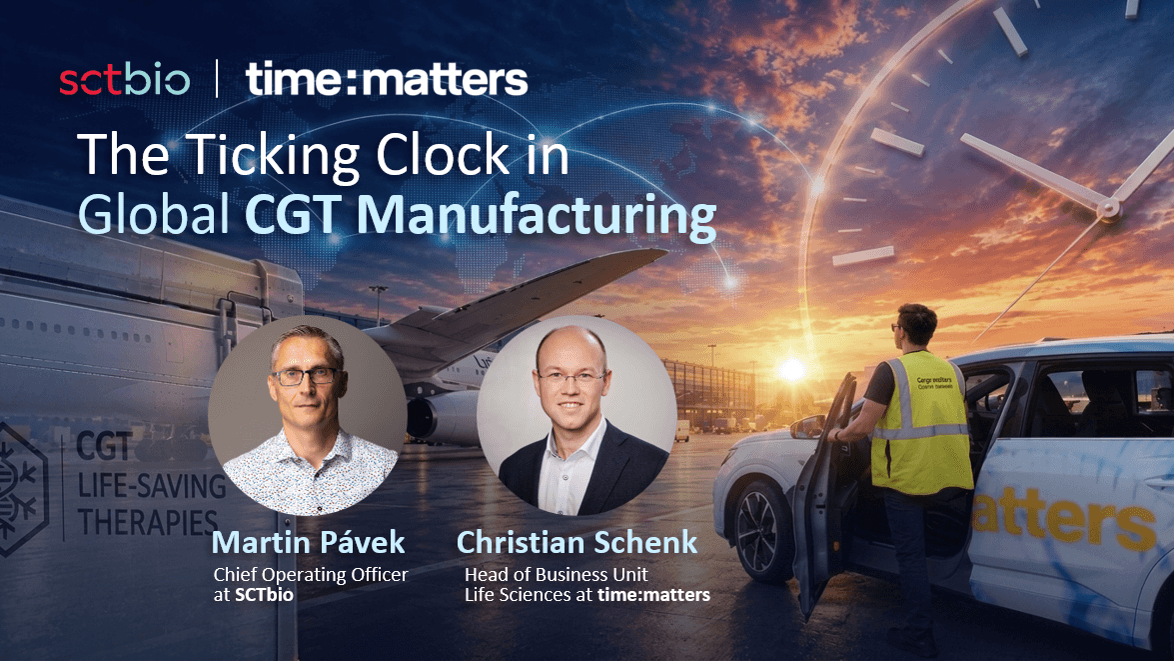
The Ticking Clock in Global CGT Manufacturing
November 12, 2026 | By Albert Pineda, PhD
Somewhere over the Atlantic, a patient-specific, time-sensitive cell therapy is racing towards a hospital already preparing for infusion. Every hour matters. But customs delays, missed connections and documentation issues can all threaten treatment timelines for critically ill patients who may not have time to spare. Before the aircraft touches the ground, however, those risks have already been anticipated, contingency plans activated and the shipment redirected toward its destination.

SCTbio team syncing a shipment with CONNECT
Cell and gene therapy (CGT) logistics often involve stakes like these, but the reality behind the scenes is not quite like an action movie. “Responding to the unexpected is what we do every day,” explains Christian Schenk, Global Head of Business Unit Life Sciences at time:matters. “There’s no drama or adrenaline; it’s a disciplined process of continuously monitoring the situation and adjusting as needed.”
That same discipline enables SCTbio’s centralized manufacturing model, allowing a single production site in Prague to serve patients across continents. “We can pick up leukapheresis material across the United States and get it here in up to 24 hours,” says Martin Pávek, Chief Operating Officer at SCTbio. “At the beginning, I thought that was impossible. Now I know it is realistic and achievable.”
Partners Grown Together
Over more than a decade of collaboration, SCTbio and time:matters have grown together as the CGT field has evolved from small regional trials into a global industry. Combining centralized manufacturing with international logistics, the partners now support complex supply chains across multiple continents.
“When we started, we were handling perhaps one or two patients per month,” Schenk says. “Today, we support an average of 20 patients every day with these highly individualized therapies, backed by a dedicated team of more than 40 specialists operating across a connected 24-hour global network.”
SCTbio matches that scale with nearly two decades of late-phase clinical-trial experience, supporting close to 150 apheresis centers and 3,000 patients worldwide. Logistics is integrated into its CDMO model: from collection planning and cell manufacturing to international transport and hospital delivery.
“Our ability to supply final product to hospitals and manage processes for sponsors, combined with the expertise we have acquired through Phase I-III studies, is a major advantage,” Pávek says. “Clinical sites tell us our logistics work much better than they see elsewhere. That’s not feedback every CDMO receives.”

time:matters on-board courier delivering a CGT shipment
When Every Minute Counts
In transatlantic CGT supply chains, unpredictability, not distance, is the main hurdle. Flight cancellations or geopolitical shifts can quickly eat into the time available for a shipment, making contingency planning as critical as the primary route.
“Disruptions happen, so preparation is everything,” Schenk points out. “Whether it is Brexit-related import delays, flight cancellations or airspace restrictions, issues emerge from many directions. We can quickly activate alternative routes and transport solutions to protect the patient’s treatment timeline.”
When every minute counts, even transportation methods must be tailored to the available margin.
“From the eastern US, 24-hour cargo delivery is theoretically possible,” Pávek explains. “However, any customs delays will cause problems. That is why, if we are targeting less than 30 hours, we generally prefer On-Board Couriers.”
Customs clearance remains the main hold-up, especially at U.S. entry points, given local risks and varying requirements across ports of entry. To reduce that risk, SCTbio and time:matters use a proactive ‘green light’ process, reviewing and approving documentation before arrival.
“Customs can easily become the biggest bottleneck in a CGT shipment, so speed at customs starts long before the aircraft lands,” Schenk says. “Pre-clearance into the US is standard for every shipment we handle. Working closely with SCTbio, our customs experts and brokers, we prepare documentation and critical steps in advance, which makes transit times much more predictable.”
Those gains extend beyond customs. In some projects, SCTbio uses conditional release to move product closer to patients before final release, further reducing the final steps of the supply chain.
“This saves three to four days for the patient,” Pávek explains. “By shipping directly to hospitals that can store quarantined product onsite, we eliminate intermediate transfers and enable immediate administration after final release.”
Operating as One
The synergy between SCTbio and time:matters is evident not only in the air but on the ground. SCTbio’s proprietary CONNECT software integrates collection schedules, transit lead times, customs rules and production slots into a single plan, allowing manufacturing and logistics to operate as one.
“Synchronization between logistics and manufacturing is critical,” Pávek says. “CONNECT links directly with our manufacturing system to coordinate collection and manufacturing schedules. The system automatically verifies dependencies, saving time and reducing the risk of human error.”
As part of the Lufthansa Group, time:matters benefits from direct access to airline infrastructure, allowing shipments to bypass standard warehouse delays and move directly between planes.
“When comparing shipments managed by time:matters against other providers, they are several hours faster,” Pávek notes. “For shipments coming from Spain, Italy, or similar locations, they can sometimes be four hours faster than competitors because of the way shipments are handled in Munich and Frankfurt. time:matters can move shipments directly from one aircraft to another.”
That same collaborative mindset extends to packaging. By preparing empty CREDOBOX™ units in line with demand through qualified U.S. providers, the partners extend the available holding time and create an even more robust setup.

SCTbio technicians preparing a cold-chain shipment
One Hub, Global Reach
For sponsors expanding CGT programs internationally, manufacturing strategy can be as important as the therapy itself. While decentralized, point-of-care manufacturing within hospitals is often presented as the future, the logistical and regulatory realities make it difficult to scale:
“In my opinion, these are castles in the air,” Pávek argues. “The fundamental question is always the same: how are you going to maintain the same level of quality across all those locations? Each hospital’s QP department would need additional release staff. It would require enormous investment for very little benefit.”
For Schenk, the deciding factor for sponsors who choose centralized manufacturing is the network that connects it to patients:
“Our global logistics network enables sponsors to manufacture in one central location while treating patients across Europe, North America, Asia-Pacific, the Middle East and beyond. We have supported programs involving hundreds of hospitals and collection sites connected to a single manufacturing facility. Sponsors can rely on one validated manufacturing process, one quality system and one production team, while we handle the complexity of the global supply chain.”
SCTbio’s location in Prague further strengthens that model. Operating within the European Union removes customs barriers between member states, increasing speed and flexibility.
“One of the biggest advantages is being located in the heart of Europe,” Pávek observes. “No customs clearance processes are needed between EU countries. In practice, we can reach almost all locations across Europe within 24 hours.”
The contrast became particularly visible after Brexit:
“The UK after Brexit is something many sponsors underestimate,” he warns. “Because the UK is outside the EU, you need customs clearance, QP oversight, and the importer-of-record requirement. If you are planning to target the European market, I would definitely manufacture within the European Union.”

time:matters team monitoring a time-sensitive delivery
Logistics Is Part of the Treatment
Ultimately, a resilient CGT supply chain treats logistics as part of the clinical pathway, not a standalone service. Engaging CDMOs and logistics providers early, ideally during preclinical development, creates a more scalable, cost-efficient model and helps avoid late-stage revalidations.
“The most successful sponsors involve logistics from the very beginning, engaging a CDMO such as SCTbio and a logistics partner in parallel,” Schenk notes. “In CGT, logistics is part of the treatment. The shipment is a clinical step, not just a delivery. Decisions made early in development can shape the therapy’s future logistics model, influencing its scalability, cost and in turn, how many patients can access the treatment.”
Behind the brokers, control towers, and proprietary software lies the human reality of the CGT sector: every minute saved directly impacts a patient awaiting a life-saving infusion.
“Our work can help give someone a chance for a better life or even save a life,” Pávek concludes. “That is why we always try to work as quickly and carefully as possible. We are always reminded that behind every shipment there is a real patient waiting for treatment and a family hoping for more time.”
About time:matters: A global provider of time-critical logistics solutions and part of the Lufthansa Group. Through its dedicated Life Sciences network, it supports the transport of highly sensitive and patient-specific therapies. Learn more at www.time-matters.com.
About SCTbio: A global CDMO specializing in advanced therapy medicinal products. Headquartered in Prague with a U.S. office in Boston, the company provides end-to-end services for cell and gene therapies worldwide. Learn more at www.sctbio.com.
Have a challenge to solve? Let's talk!
If you need cGMP cell manufacturing, viral vectors, process development, or end-to-end CDMO support, our team is ready to help.
or visit us at www.sctbio.com
Want to learn more?
This article is part of our series on SCTbio's expertise, case studies, and ATMP programs. Discover more insights in previous publications: