The Data Bridging Revolution: A Vision for Predictive Apheresis Network Management
December 17, 2025
Insights from SCTbio's webinar featuring Hugo Fabre (Terumo Blood and Cell Technologies), Dr. Nina Worel (Medical University of Vienna), and Jesus Fernandez-Sojo (Barcelona Cell Therapy Services)
Information Islands
Today's apheresis operations generate vast amounts of potentially valuable data that largely goes unused. Information often doesn't travel freely between prescribing physicians, people managing the washout of those therapies, and people collecting the cells.
Device-generated run data files capture detailed information about every procedure: system configurations, procedural targets, real-time adjustments, and operator actions. Yet this treasure trove of operational intelligence rarely connects with the patient biology data that determines therapeutic success.
From SCTbio's perspective of managing collections across more than 100 sites in Europe, we see this disconnect daily. Critical decisions about collection timing, procedure parameters, and quality expectations get made with incomplete information. Each stakeholder operates with their own view of the process, unaware of the integrated picture that could drive better outcomes.
Moreover, procedural notes often remain paper-based and vary significantly from site to site, while patient data sits in electronic medical records that don't communicate with collection systems.
The result is reactive management rather than predictive optimization.
Defining Data Bridging
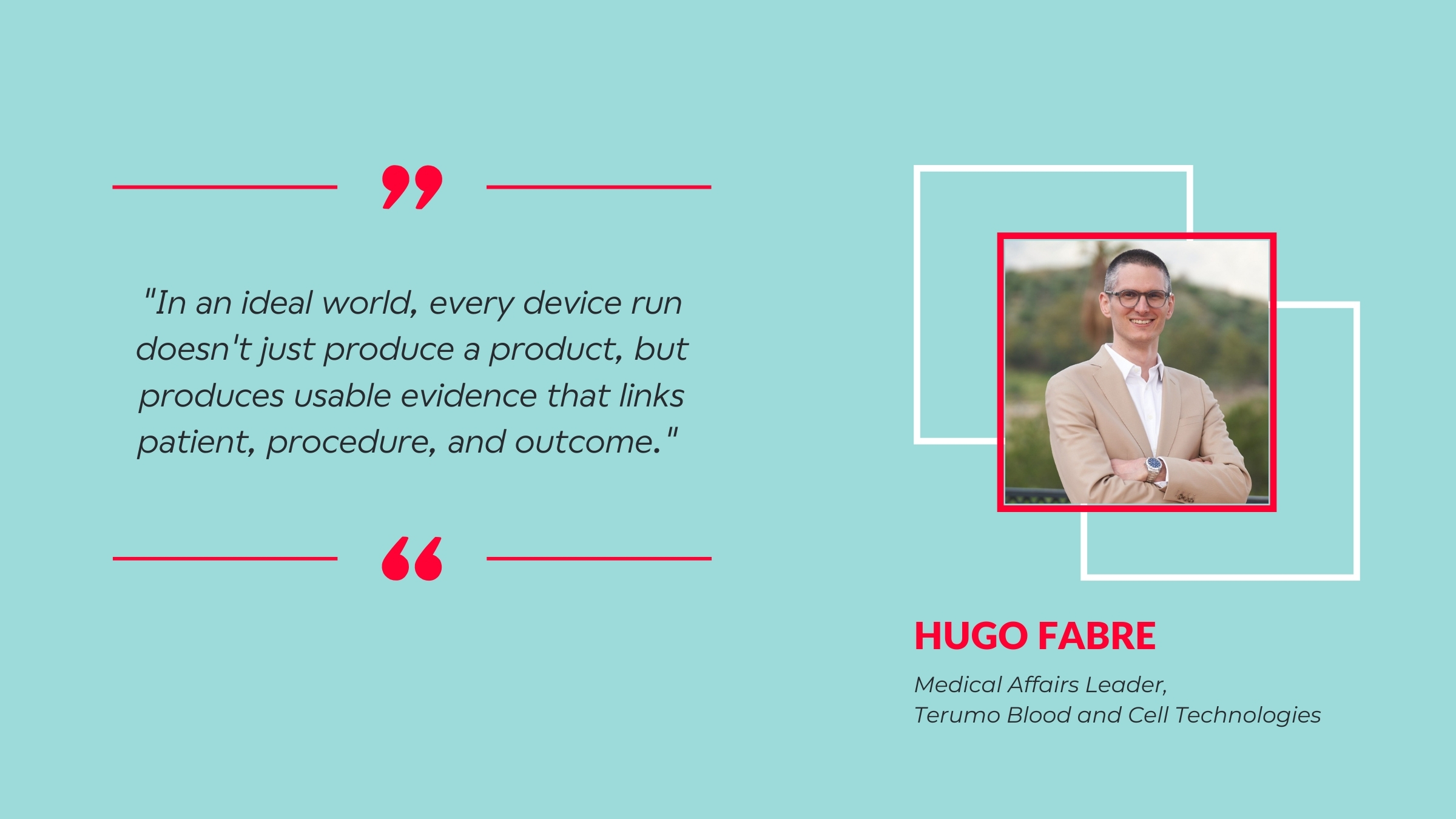
The vision of data bridging represents a fundamental shift from reactive to predictive network management. In an ideal world, every device run doesn't just produce a product, but produces usable evidence that links patient, procedure, and outcome.
This concept involves three critical data streams converging into centralized decision-making tools:
- Device Data: Real-time procedural parameters, efficiency metrics, and system performance indicators. Device-generated run data files (RAN-DTF files) are created every time a new procedure happens and can be a goldmine of information, capturing every system configuration, every procedural target, and real-time adjustments.
- Procedure Data: Standardized documentation of operator actions, timing, and qualitative observations that affect collection outcomes.
- Patient Data: Biology, therapy history, and clinical context that determines what's achievable and what parameters matter most for therapeutic success.
This integration creates something greater than the sum of its parts: predictive models that not only monitor collection quality, but anticipate manufacturing challenges and therapeutic potential.
Transforming Network Operations
Current network management operates largely in reactive mode. Quality issues surface during manufacturing or, worse, during patient treatment. By then, the opportunity to optimize or rectify has passed.
Data bridging enables a different approach. By reporting both quantitative and qualitative parameters, networks can move from describing a bag of cells to predicting therapeutic success.
Imagine a dashboard where device performance data feeds into procedural performance indicators, all contextualized by patient biology. These systems could identify patterns that predict manufacturing challenges before they occur:
- Which patient factors combined with specific procedural parameters lead to downstream processing issues?
- How do real-time device adjustments correlate with final product quality?
- Which collection efficiency patterns predict therapeutic success versus failure?
Procedural variability is one of the few risks networks can actually control. Data bridging provides the real-time insights needed to manage it proactively rather than reactively, enabling immediate adjustments rather than post-hoc analysis.
Accelerating Network-Wide Learning
One of the most compelling aspects of data bridging is its potential to accelerate learning across entire networks. When properly analyzed across multiple sites, device data enables meaningful benchmarking, remote troubleshooting, and identification of training needs.
We've seen how sharing insights between sites can rapidly improve performance, but current approaches are based on periodic meetings and manual knowledge transfer. Data bridging could automate and accelerate this process.
By establishing a common language at the device level, networks could enable meaningful benchmarking across geographies. European centers and US centers could finally harmonize, sharing insights that improve outcomes globally.
The learning acceleration would be significant. Instead of slowly accumulating experience one collection at a time, networks could rapidly identify best practices and distribute them across all sites simultaneously.
Every collection becomes a learning opportunity for the entire network.
The Implementation Reality
Networks that master data integration will likely gain significant advantages in delivering consistent, high-quality starting materials. The ability to predict rather than react represents a fundamental shift in operational capability.
Consider the implications. Instead of discovering collection quality issues during manufacturing, networks could adjust parameters in real-time during collection. Rather than treating each collection as an independent event, networks could apply insights from thousands of procedures to optimize every new case.
This transformation creates a perpetual feedback loop: insights learned here inform what needs to be implemented there. From our operational standpoint, this represents the difference between managing situations and preventing them. Our experience with weather disruptions, viral-positive materials, and equipment failures has taught us that predictive capabilities dramatically reduce operational stress while improving patient outcomes.
The technical challenges of achieving this integrated digital infrastructure are significant but surmountable. Creating systems that can bridge traditionally separate data streams while maintaining the flexibility that successful networks require demands sophisticated integration capabilities.
More challenging may be the organizational changes required. Data bridging requires unprecedented collaboration between device manufacturers, collection centers, and manufacturing facilities. It demands standardized data formats, shared quality metrics, and aligned incentives across stakeholders who have traditionally operated independently.
From a technology perspective, manufacturers are already working across multiple sites to analyze patterns, identifying which settings correlate with higher yields and which configurations consistently reduce alarms. The foundation exists; the challenge is integration and standardization.
Privacy and regulatory considerations add another layer of complexity. Patient data integration must comply with varying international standards while enabling the cross-border coordination that global networks require.
From Vision to Reality
Despite the challenges, the potential benefits make data bridging inevitable. Networks that begin building these capabilities now will establish significant competitive advantages in an increasingly complex therapeutic landscape.
The first steps involve establishing common data formats and metrics across network sites. This enables meaningful comparison and analysis—the foundation for predictive modeling. Device manufacturers and network operators must collaborate on data standardization while maintaining the flexibility that different therapeutic approaches require.
A practical framework for implementation involves taking an inside-out approach: starting with device staffing, rolling out to multiple sites, and then assessing how this whole machine works together.
From our combined experience with the expert panellists, we recommend starting with pilot programs that demonstrate value before attempting full network integration. Success stories will drive broader adoption more effectively than theoretical benefits.
In Conclusion…
The data bridging revolution represents more than a technological upgrade. It's a fundamental reimagining of how apheresis networks operate. Instead of managing collections in isolation, networks could orchestrate integrated systems that optimize therapeutic outcomes from collection through treatment.
For an industry focused on delivering breakthrough therapies to patients who desperately need them, the ability to predict and optimize success at every step of the process represents a transformational opportunity.
As described in the webinar discussion, in a perfect world of standardization we would have integrated dashboards where device data feeds all procedural performance information, contextualized by patient biology, with predictive models that tell us not just what we collect, but what it means for downstream success.
The question isn't whether data bridging will transform apheresis network management; it's which networks will lead the transformation, and which will struggle to catch up.
On-demand
This article presents insights from SCTbio's webinar "Global Apheresis Network Management for Cell and Gene Therapies," featuring expert panelists who collectively manage over 75 collection centers across Europe. Watch the full discussion on-demand to hear additional insights from Dr. Nina Worel (Medical University of Vienna) and Jesus Fernandez-Sojo (Barcelona Cell Therapy Services) on network coordination, standardization challenges, and proven scaling strategies.
Related Resources
This article is part of our ongoing series on optimizing apheresis operations and starting material quality. Dive deeper into the strategic considerations shaping the future of cell therapy development:


Want to discuss your apheresis challenges? Schedule a 15-minute consultation with our network specialists to explore how standardized partnerships could benefit your programs.